
Data collection - str()
Properties of list:
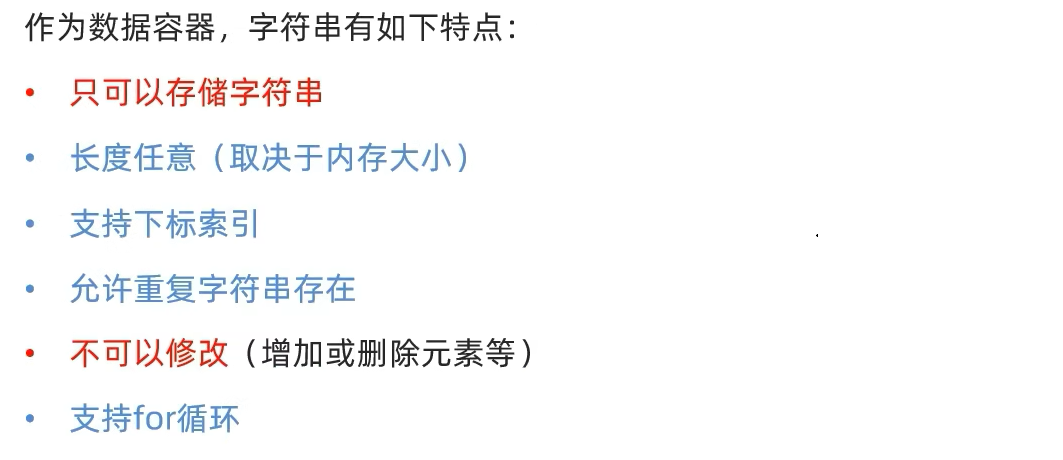
the data cannot be modifed after defined- means that
changes will not apply on old variable name, but you cancreate a new variable name to store it.
- Related to basic usage of string: Click here.
str()can be considered as data container because thetext insidea str() can bestandalone.
Example:
py
text = str("Hi")
print(text[0])
print(text[1])
Output:
H
i
Usage & Method
str-collection-usage.py
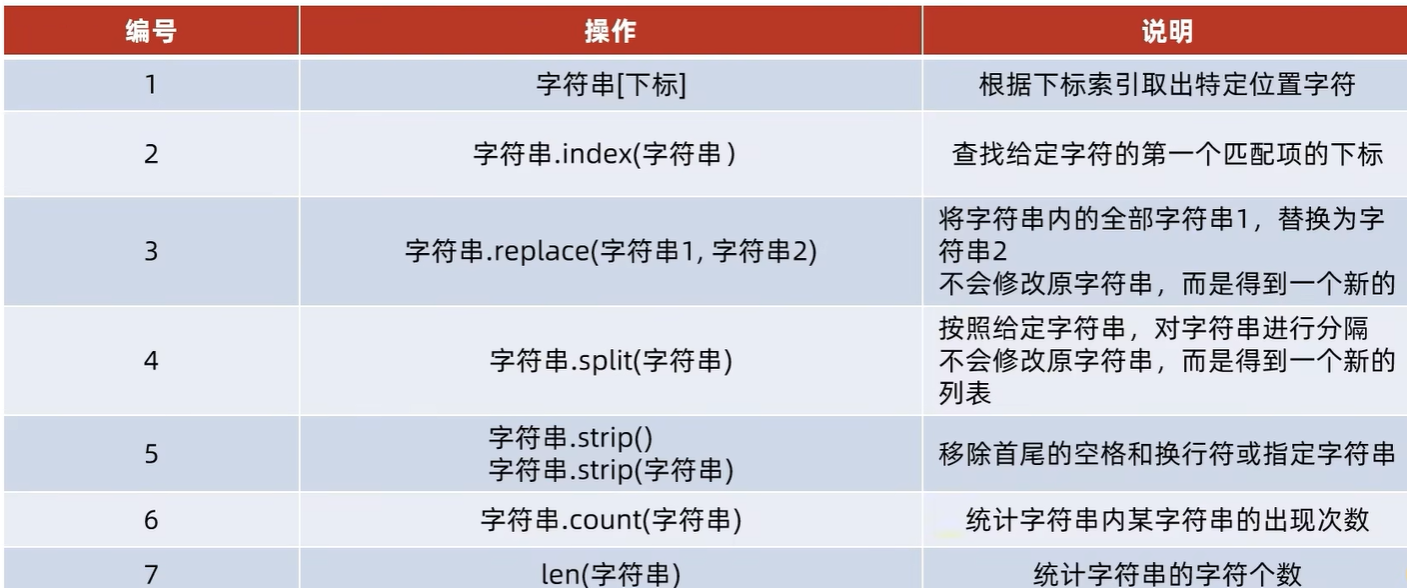
1. Get element in a string
py
str_text = str("Hi, John's Dog")
#               01234567891111
#                         0123

# get element in a string
print(str_text[11]) # D
print(str_text[12]) # o
print(str_text[13]) # 9
Output:
D
o
g
2. Get the length of a string, len()
py
# get length of the string
print(len(str_text)) # 14
Output:
143. Find a number of repeated text, text.count(match_value)
py
# find number of o in a str
print(str_text.count("o"))
Output:
24. Method - index()
py
# index of text "o"
print(str_text.index("o"))
Output:
5Info
It only will return first match position / index.
5. Method - replace()
py
# Replace dog -> cat
new_str_text = str_text.replace("Dog", "Cat")
print(new_str_text)
Info
It can't change the old string directly, it only can store the changes on a new variable.
Output:
Hi, John's Cat6. Method - split() 切分
py
# split()
new_text = str("Hello Hello John")
results = new_text.split() # remove space ( )
print(results)
print(type(results))
Output:
['Hello', 'Hello', 'John']
<class 'list'>
Info
- It can't change the old string directly, it only can store the changes on a new variable.
- And It will
returning a new list.
7. Method - strip() 规整操作
- Will remove the text contains if it matches (on front and back only)
- if matches value =
"12", it will remove if contains["1", "2"]
py
new_text_2 = "######21####Hello Ben#############12##"
stripped_text_2 = new_text_2.strip("12#")
print(stripped_text_2)
Output:
Hello BenConclusion
Comprehensive Example
Given:
Hi Hello HolaFind number of time that 'H' exist.
replace the space " " to "|".
Spliting the string based on the "|"
Hints:
count,replace,split
str-data-collection-ex.py
py
text = str("Hi Hello Hola")

# Find number of time that 'H' exist.
print(text.count("H"))

# replace the space " " to "|".
new_text = text.replace(" ", "|")
print(new_text)

# Spliting the string based on the "|"
new_text_2 = new_text.split("|")
print(new_text_2)
Output:
3
Hi|Hello|Hola
['Hi', 'Hello', 'Hola']