Set 集合 {}
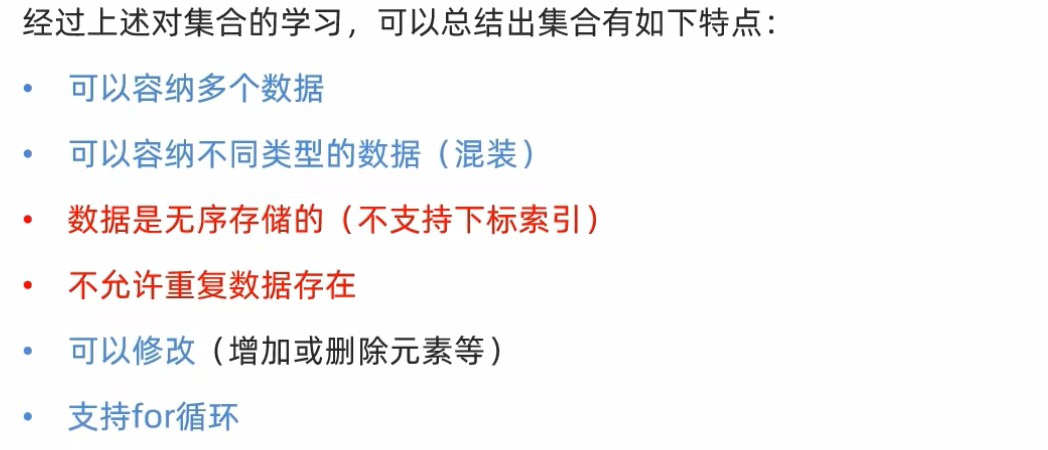
Properties of Set:
- It
doesn'tsupport repeated data. - It's unordering so it
don't have index. - So, it's
suitable to remove repeated data. - It's
unorderingfeature will cause the set item ordering changes. - It also allow to make changes to the data.
Syntax
Define Set
py
set_1 = {element1, element2, elementN}

# Empty set
set_empty_1 = set() # <class 'set'>
set_empty_2 = {} # printed type = <class 'dict'>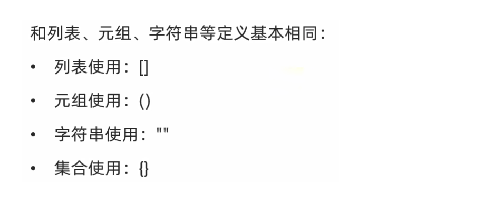
Common Usage
set.py
Define a set
py
# Define a set
fruits_set = {"Grape", "Kiwi", "Banana", "Apple", "Mango", "Watermelon"}
print(fruits_set)
print(type(fruits_set))
Output:
{'Mango', 'Grape', 'Banana', 'Kiwi', 'Watermelon', 'Apple'}
<class 'set'>
Add an element
py
# Add an new element
fruits_set.add("Orange")
print(fruits_set)

# Try add repeated data
fruits_set.add("Grape")
print(fruits_set) # Grape has repeated, python will remove if same.
Output:
{'Grape', 'Orange', 'Apple', 'Watermelon', 'Mango', 'Banana', 'Kiwi'}
{'Grape', 'Orange', 'Apple', 'Watermelon', 'Mango', 'Banana', 'Kiwi'}
Remove an element
py
# Remove an element
fruits_set.remove("Apple")
print(fruits_set)
Output:
{'Banana', 'Kiwi', 'Grape', 'Watermelon', 'Orange', 'Mango'}Randomly get any one if the element from the set
py
# Get an random item from the set
# set.pop() means remove item, since it dont have index, random item will be removed
random_item = fruits_set.pop()
print(f"{fruits_set.pop()} has been removed.")
print(fruits_set)
Output: (1st trial)
Mango has been removed.
{'Orange', 'Kiwi', 'Banana', 'Grape'}
Output: (2nd trial)
Banana has been removed.
{'Kiwi', 'Mango', 'Grape', 'Watermelon'}
Clear the set
py
# Clear entire set
fruits_set.clear()
print(fruits_set)
Output:
set()Info
set() means empty set.
Combine a Set (Union)
py
# Combine / union a set
set_a = {1, 2, 3}
set_b = {1, 4, 2}
set_c = set_a.union(set_b)
print(set_c) # Combine + remove repeated
Results:
{1, 2, 3, 4}Get length of the set
py
# Get length of the set
set_alpha = {5, 5, 0, 6, 7, 8}
print(len(set_alpha)) # Still remove repeated data, 5
Output:
5Iterating over a set
- Since set
doesnt have index, so wecan't use while loop butwecan use for loop.
py
set_for_iterating = {"John", "Delton", "Alison", "Ed"}

for i in set_for_iterating:
    print(i)

original_set = {0, 1, 2, 3, 4, 5, 6, 7, 8, 9}
plus_1_set = set()

for item in original_set:
    item += 1
    plus_1_set.add(item)

print(plus_1_set)
Output:
Delton
Ed
Alison
John
{1, 2, 3, 4, 5, 6, 7, 8, 9, 10}
Usage - Difference
Find the difference between 2 set and form a new set
py
new_set_1 = {1, 2, 3}
new_set_2 = {2, 4, 6}

# The same element on this 2 sets: 2
# Different element on this sets 1 and set 2:
# Set1 = 1, 3
# Set2 = 4, 6

# Get the difference between 2 sets
different_set_btwn_1_2 = new_set_1.difference(new_set_2)
print(different_set_btwn_1_2) # {1, 3} only exists on set_1

different_set_btwn_2_1 = new_set_2.difference(new_set_1)
print(different_set_btwn_2_1) # {4, 6} only exists on set_2
Output:
{1, 3}
{4, 6}
Find the difference between 2 set and update the set
py
set_3 = {0, 1, 2}
set_4 = {1, 3, 4}

# Repeated data = 1
# find the difference between set 2 and set 1, and remove the repeated and
# return a new set without the repeated element
set_3.difference_update(set_4)
print(set_3)
Output:
{0, 2}Conclusion